Odette D’Aniello 4:00
That’s great. So, what grain is that is that flour oat?
Bridget Greaney 4:06
That’s almond flour. So we use all of our now our product would recall rounds look like two mini donuts packed in an individual pack. At the time in college, they weren’t mini donut shaped, but, that sort of a play on healthy, nutritious and delicious. And all of our ingredients are all of our recipes are grain free, gluten free, no dairy, no egg, no soy. So, almond flour was our first ingredient.
Odette D’Aniello 4:39
That’s delicious. So you, you were making these and you just give them away to friends, and that’s how it started?
Bridget Greaney 4:48
Yeah, at first I was making them and like storing them in large ziploc bags. It was kind of like a loose granola version of our maple cinnamon flavor, which is a popular neighbor of ours, and my roommates started, you know, taking a little bit and crumbling and up on their yogurt or asking like, what is this? Can I have some and I kept making more because the bag kept like going, you know, getting depleted. And then I was home over a break during senior year, I don’t remember exactly what time of the year and my parents tried it. And they were like, This is really good and better than anything else they were eating. And then my mom, you know, Nancy, who’s here, obviously, with us had a previous business career and an office that was running like a health program for their employees. And so I brought some in and sampled it with some of her employees. And before I could even leave the sampling event, they had emailed her many people at email, my mom asked me for the recipe, and I never gave out the recipe I just always made more. And that was sort of indicative to like, oh, well, if you can’t keep up making making enough at home, maybe there’s like some need for this product, because people seem to really resonate with it.
Odette D’Aniello 6:03
So Nancy, how did you provide all those snacks for your office Did you just ask Bridget to make more? How did you end up scaling it? Now you’re in all these stores.
Nancy Becker 6:15
Yeah, well, there’s a lot behind that. Well, at the time, I was a partner in another company. And I we luckily, as time would have it, I was sunsetting over there and able to help focus when she asked me to help her on, you know, how can we take this to market and you know, of course, we looked at co packers, and we looked at doing it ourselves. And we were fortunate we manufacture out of Baltimore, we’re from Maryland originally. And we were able to do that in a way that gave us control over our costs, our r&d, and, you know, our food waste, you probably know in this industry knows co-packers have minimum order quantities that when you’re just starting out are way excessive, and we knew we couldn’t do that. So I had the wherewithal, me and my husband are the investors. And you know, we’re doing fine (knock on wood). And, you know, we’ve been able to, as Bridget always says, Mom, let’s not get ahead of our skis. And we have and we continue to scale, as makes sense. And day one, Bridget was making the product, I was fulfilling it, we haven’t done that in years.
So you have your own facility?
Bridget Greaney 7:34
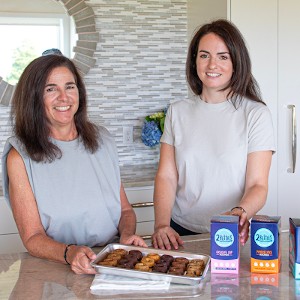
Yeah, we are not backing and that was. So again, like not coming from the food space. I went to college at the University of Wisconsin Madison, which has a great food nutrition and legal food nutrition program they’re on. And I studied anthropology and Political Science, which has nothing to do with food and nothing to do business, although you could argue otherwise. And my senior year, instead of graduating early, I ended up taking some classes in like food law and nutrition. And was, you know, fortunate to be able to do so because those professors are really helpful. And I started to wrap my head around, like what I wanted to do here, and co-packers and co-manufacturers, you know, was is still you know, very much relied upon, for food startups to get just production underway, and even to get r&d underway for products to, to launch a business around. But there’s a reason there’s not a lot of mini donut shaped snack products. Because a lot of the co-packers don’t make mini donut shape products. They make bar-shaped products or cookie shaped, round shaped product and our our dough is not similar to a cookie. So in talking to co-packers out the gate, you know, for a business that didn’t exist for two co-founders who were mom and daughter and had no experience in the food space, they were not interested in really hearing much more about what we were planning to do, which I totally understand. You know, we had to kind of go prove concepts and in proving concept and getting our own space in Baltimore, Maryland. And just as continued, like my mom said, to make sense for us to continue to manufacture ourselves. But that was the reason out the gate was just you know, there wasn’t a lot of interest to help to support making this type of product in this shape.
Odette D’Aniello 9:29
Absolutely. Because when you hire a co-man there is there are minimums, and your product will have to fit in the line and the equipment that they have already. They can’t be installing some extruder for donut shapes.
Nancy Becker 9:46
Right, There weren’t a lot of gluten free manufacturers, co packers.
Bridget Greaney 9:53
There’s more now. Yeah. And even like what you just mentioned the minimum order quantities like there was one that one was interested that had the capabilities for gluten free manufacturing. But again, hitting those minimum order quantities not knowing necessarily what like consumer interest would be of the product or how to even drive drive sales effectively, for our product at that time, it just didn’t make a lot of sense to commit to, like 1000s of units of product where the probability of food waste is high, which we were not supportive of. So that’s just been sort of how we’ve gone about making our product and making decisions around manufacturing ourselves.
Odette D’Aniello 10:37
So when you started manufacturing yourself, Who were your ideal customers to begin with? And who are they now?
Bridget Greaney 10:45
So I think, coming from a business background, and my co founder and mom, I was fortunate to have her there alongside me, you know, when we launch because you she had really good advice, which was that we need to go figure that question out, right, instead of just making an assumption. And we went and stood outside of a couple grocery stores, right after I graduated that summer. And we had, you know, iterations of the product, the product at that time, we were playing around with the doughnut shape of it. And we were playing around with different flavors within you know, variations of the flavor. I said that maple cinnamon is sort of the original flavor, so exists still product we offer. We took those and smaller Ziploc bags and stood outside of grocery stores, asking first a snack survey that we came up with just general questions around consumer snacking. And then if they finished that portion of the survey, we introduced an offer then the opportunity to continue on to a survey actually sampling early versions of the product. The first portion of the survey was so interesting, because people were coming out and this was not a whole foods, you know, it wasn’t a Trader Joe’s it was more of a similar to like an all the, like a discount, more bulk focused grocery store. And these customers are coming out of the grocery store saying that they consider a snack for themselves to either be like a carrot, or a Oreo cookie, or a Nature Valley bar. And so one of the things and I didn’t mention this earlier, but like one of the things too, that I was finding for myself, when I was at college is like you could have the cookie or brownie, or you could have like raw fruits and vegetables, but like the image, the image. And the image mean of those two things like there wasn’t a lot of options. And you could either go in between and like go super healthy, like kale chips, which are kind of gross, in my opinion, and are not palatable to a lot of people and then or you could try to do like higher protein snacks and things like that. But they have a lot of artificial ingredients and a lot of funky things going on artificial sweeteners that maybe just aren’t again, palatable. And nutritionally, like I said, sometimes no better than just eating candy bar. So from that experience that’s always kind of shaped our focus on our customer, it’s driven by the customer. So, you know, people have always been like, Well, why aren’t you in Whole Foods yet? Like, because the whole foods customer knows like they’re more savvy in terms of nutrition, and you know, what types of food choices they’re making? We’re trying to make a snack that is nutritious and delicious. For the average consumer, someone who might think an Oreo, you know, a couple Oreos is a snack when in reality, that shouldn’t be a snack, because that’s more of a dessert.
Nancy Becker 13:39
And when we did this survey, Bridgette knew, I said we have to see this as a wow product. And so when they finished the first part of the survey, which was general questions on how they snack, then we offered them our snack and said we were representing the snack company. It was interesting. They never asked to sign the waivers. We took a leap of faith and so did that. But anyway, they, they people would bite into it. And I literally I counted eight out of 10 people were like, wow, and the other two were like, Oh, this is okay, this is good. And so I knew right away she had a “WOW,” other than friends and family, because we really I knew friends and family were like, you know, Oh, we love it, you know, but this was interesting, and really propelled us to get more serious about okay, what do we do next? But first was figuring out the customer Bridget’s pin point, we realize we could be approachable that just about any consumer, not just those that are already predetermined to go to a Whole Foods or you know, whatever.
Odette D’Aniello 14:46
So what do we do next?
Bridget Greaney 14:48
Um, from that point, right. It was like okay, we have a product that would be interesting, I think on the shelves, and we worked with a local chef in Baltimore to make sure the flavor was there, you know, across a couple of different skews. And then we worked with a food scientist at the University of Maryland to make sure that what I was making at home was, you know, safe to consume and scalable for shelf life to support distribution. And then beyond that was, you know, just basically establishing the brand and launching online, which was, you know, I think that’s a really easy place to start, you can throw up a website pretty easily and cost effectively these days. And it can be your full branded experience where our packaging at that time was not anything to write home about, it was just clear packs with little hand, apply labels, you know, we just kind of hobbled together and we got an initial feedback from friends and family. And we had, we’ve always had the business like this where we set hypothesis around what it is that we’re testing and so that early those early days, right, we had like three hypothesis, it was like, one, if we launch this online to friends and family that will see word of mouth pickup and will start to see us but you know, a spin off of organic purchases coming in from people we don’t know. Two, we’ll see retention, like off of those initial orders, and three that we would be able to see like customer reviews, and things like that that are positive. And all three of those things became a Yes, pretty quickly. In fact, we being in Baltimore, which is a you know, great city, and we love it there. But it’s also a smaller city on the East Coast relative to New York or DC. We had some PR coverage as a new emerging snack brand around Mother’s Day and when we launched in 2018. And that piece of coverage for some reason got picked up online through other affiliate news stations. And we had interest from a Whole Foods that was in Laguna Beach, California, from a buyer or manager, store manager, their buyer. We had an email in our inbox, it was like, hey, like we have a customer who loves your product and has come in and asked for you guys to be carried here. Like do you sell wholesale? You know, I don’t know much about your brand. And we read that email. And this is like, what May? What we just launched in January? And we’re like, No, we don’t, unfortunately. But we took that as you know, the final step to okay, we need to go get packaging that shelf ready and kind of take who that customer is that we’re seeing kind of online, take it and go test it and in store. So we went to fitness studios and coffee shops and did a ton of different events all through 2019. Just building the brand and continuing to test our product hypothesis in different formats. So that was the next step.
Odette D’Aniello 17:51
That’s so brilliant. That’s amazing. That’s a really smart way to do it, too. Yeah,
Bridget Greaney 17:58
and when it was working, and then of course COVID happened. So COVID We were not, you know, our business plan was not pandemic-proof. And we definitely, you know, I think everyone across the world, obviously was finding themselves in a new norm. That was kind of crazy. And I feel like collectively, we’re all just finally getting fully past it potentially. But our business strategy for growth for 2020 was to kind of build off of that wholesale growth that we had in 2019 and start to go after, you know, we were in a couple of mom and pop natural grocers, but started to kind of build off of that, that was not pandemic proof. Because another thing in addition to manufacturing ourselves, at that time, we distributed ourselves 100%. So we knew that and then again, that was just in an effort of saying super close to our customer, whether it’s the grocery store, you know, buyer or the end customer, like we wanted to know what was happening. We want to know where the product was sitting, what is what skews were moving and why was it moving or not moving to be able to go in there and do samples and demos or do events. Um, so towards the end of 2020, you kind of regrouped and found our stride back on that online channel. And then now where we find ourselves as again, focused on both channels, but with wholesale being a bigger focus for us for this year.
Nancy Becker 19:28
I’ll add after a lot of the fitness and smaller retailers did not come back and, unfortunately, some of them went out of business. One wholesale account that I have to say we got early on and has been with us forever is the Baltimore Ravens team. They call the 2Betties their healthy donuts. So when Bridgette got an email from them saying we need to reorder our healthy donuts. She was like Mom, and you know that was back to the Bridget’s point when we launched we did an online friends and family and one of our friends knew someone in the Baltimore Ravens’ front office and they asked for a box and then they sent it to the dietician, and we’ve, knock on wood, been approved by their dietician, as well as the American Kidney and American Diabetes dietitians.
Odette D’Aniello 20:18
That’s fantastic. Yeah. So now, where are you distributed? Did you actually go into a distribution channel? Are you now distributed?
Bridget Greaney 20:29
So we are, we have a regional distributor out of New York called River Valley, who we love working with. And again, that’s part of the intentional and part of our playbook here, which was, we, you know, we know the UNFIs, we know the KeHe’s, you know, the other larger distributors out there. And we also know, a lot of food brands who have come and gone because they’ve gone and gotten into way too many stores way too quickly and haven’t don’t know how to drive, you know, velocity within the stores that they get in. So, I’m, again, wanting to avoid food waste, wanting to stay close to our customer wanting to make sure that what our hypothesis is that, you know, we have a product that is really good, and people want and will consume and will consume over a long period of time. Um, you know, every data point is a new test on that, right. So our focus on distribution has been focused on the mom and pop natural groceries, you know, supporting those stores, and really testing and seeing how that’s going. It’s going well with River Valley. And we do have, hopefully, on our horizon for this year, larger grocery accounts that would need support through larger distribution. And I say it that way, because our focus is on the end customer not on getting distribution to get in stores, and trying to figure it that way.
Odette D’Aniello 21:54
Right. So you’re just focusing on the customers and getting their feedback. And then moving forward from there. Yeah,
Bridget Greaney 22:01
So focus on like stores where we know our customers are going from our online channel where we send surveys and interview and ask our customers like, where are you shopping? Where do you want to buy our products? And then going from that direction?
Nancy Becker 22:16
Yeah. So we’ve learned our product, a lot of people think of it as a breakfast, grab and go. And we compete. You know, one of our visions is to be the healthy Nabisco, not one of them, you know, and we compete with Belvita. Breakfast, you know, and you would only learn that from being close to the customer.
Odette D’Aniello 22:39
You know, you know what, I love to find 2Betties on the airplane because they always give you this, like, pretzels and things. I mean, they’re delicious. I actually talked to the person who owned that pretzel company that was in the airlines. And he was just like, how did you get in? There? He goes, luck. Yeah, I’m wishing you all the luck.
Bridget Greaney 23:07
Yeah, no shame in pretzels and a ginger ale on a flight. But yeah, I would love to find our product there.
Odette D’Aniello 23:14
Exactly what I drink. I never drink soda, but ginger ale.
Bridget Greaney 23:19
It’s better when you’re flying, I think. Yeah, I think, you know, we’ve also been like, slow and steady, like I said, like we launched in 2018. Obviously, I’m fortunate to have my mom as my business partner and as our only investor at this point. So, you know, we are in full control of our destiny, what we do and how we do it, which I think that is something to not be taken for granted. But it also I think it takes time, right? It takes time to learn and to gather the data points around, like what is happening with the product and where to go with things my mom mentioned just now, like, in the past two years, since COVID, we’ve been working with locally, the National Kidney Foundation and American Diabetes Association. That was never something that when we launched would have been a thought of mine, but our product does not spike blood glucose. And then super simple ingredient list with no sodium. Diabetes is a precursor to kidney disease. So you know, no sodium and no refined sugar, no blood glucose. Our snack is supportive for patients of diabetes and early renal disease. That’s a huge population of people. I don’t know the number right off the top of my head, but it’s like, you know, maybe like as big as 1/3 of the population has diabetes or renal disease it’s insane. And our snack, we know from the way we know the way we connected the dots on that was from our customers saying leaving review saying I love your snacks because they’re don’t spike my blood glucose. And so we had to look into that. What does that mean? I’m fortunate knock on wood right now to not be diabetic, but like, I didn’t know what that meant, or what impact that was having to our customers. And that’s a really big one.
Odette D’Aniello 25:11
That is a big one and, and to to just have that feedback that is being used by people who are diabetic, pre-diabetic or have renal diseases that increase demand. And so do you make any claims?
Bridget Greaney 25:28
We don’t right now. We do still work with the same food scientists that supported us early on. And I’m smiling because so many of the people early on that supported us were just doing it because they like loved what we were about. And now she it’s fun to have her working for, like more established working for us. And to continue to work with us. And no, we don’t make legal claims around that at this point on our packaging. But we do have testimonials from those, you know, those NKF, National Kidney Foundation and American Diabetes Association dieticians in support of providing to better use for their patients.
Nancy Becker 26:15
Dieticians asked at the National Kidney Foundation asked to do their monthly meeting at our facility. And they’ve approved us. But to Bridget’s point, we’re not endorsed by them, nor do we have the rights to make claims. But our test, we have to highlight more testimonials, and we will, but you’ll find it in reviews and so forth like that.
Odette D’Aniello 26:40
The testimonials is the safest way. Because when you make a claim…
Bridget Greaney 26:43
The claim space, I think you know, where you’re in the food space, like, it is a little daunting, especially for a small brand. Just knowing like, some of the lawsuits that come out out there, you know, just attacking food companies that you know, I know our brand through and through. And I know us as founders and leaders here like we have only the best intentions of what we are only human so a mistake could be made. But I know like in you get bigger and bigger companies. And you know, who knows. So I understand why there is legal concern over claims.
Odette D’Aniello 27:22
Well, yeah, we just don’t make any claims. We just say it’s allergenic. Don’t eat it if you’re allergic. Yeah. So that’s basically that’s I used to own a chocolate fudge company. And it was the first chocolate fudge company. It’s called Wax Orchards. And the first chocolate fudge company that used fruit juice to sweeten it. So in the 80s, when it was started, I had purchased the company a few years back, but when it started, it was the only dessert that diabetic people would use as dessert. So we have this great following. And we had to pull all of those claims because it requires human blood right to to get, it’s a lot but you know, I do feel that if there is that demand. It becomes this crucial part of people’s lives because it’s like their lifeline for snacking, and it gives like the day a kind of a like a happy point like I snack today. And there’s something delicious today that I can eat. So that’s, that’s a fascinating story. I love how you guys have grown because I think what happens with CPG companies, they want their products on the shelf, we want to see our products all over so that when we travel, we see it and then you can be proud of it. But I think that our listeners, especially those in the industry, that cost money and a lot of CPG companies lose their behinds because it costs so much money, any kind of discounts, any kind of specials, any kind of that is out of the pockets of manufacturers.
Bridget Greaney 29:14
Yeah. I mean, even when I shared earlier like getting that email from a Whole Foods buyer out in California, like it was hard to say no, it was definitely the right decision. Because even now like thinking about that though of how little I knew, even just from what you just said pricing and promotion. Right? You have got to have your T’s crossed and your I’s dotted when you’re starting to go into larger chain grocery stores like that, which we definitely do now. We definitely did not when we launched.
Odette D’Aniello 29:48
Do you guys co-pack for other people?
Bridget Greaney 29:54
We don’t. Our facility right now is 100% for us although we do have capacity. The in terms of time within our facility that could for another brand, and we’ve been approached, and are considering that but at this point no.
Odette D’Aniello 30:11
Okay, I’m just thinking about it because there’s so many people are looking for gluten-free co-packers, well co-packers period.
Bridget Greaney 30:19
If someone’s listening and looking for a Baltimore area gluten-free Baker, we may be a resource for you, and we definitely know how to point you in the right direction. But we don’t currently have any other brands that we’re co-packing for.
Odette D’Aniello 30:34
Well, that’s great, but that you’re there and ready to go hopefully, if, if the need arises. And yeah, that might be an opportunity. But I just wanted to I have another question. So I run my business with my daughter, how does how is it running a business as mom and daughter team?
Bridget Greaney 30:53
I think it’s fun, I mean, the pause, Mom. You want to jump in answer. You’re the boss, we’re very fortunate to have always had a very good mother/daughter relationship. And I think if that wasn’t the case, we would never have even considered launching a business together. Obviously, any relationship, right takes communication, and it does take work. And I think that’s, you know, no exception when it’s your mom as your business partner. But we are fortunate to have just totally different approaches to things, different views on things, different age points of reference, different experience points of reference, my mom that, like I mentioned the business career in a totally different space. And I’m doing this out of college. So in that I think it’s constantly working towards that middle ground of seeing like where one’s perspective is, you know, where we can meet in the middle. And in that space, there’s a lot of a lot of opportunity. It’s been really fun. That’s
Nancy Becker 31:58
I would add a couple things. One, when Bridgette was five, she says she was seven, we went to large, known consumer retailer for me to pick up a birthday gift. And they were a mess, I was looking for like an oxford shirt, they didn’t have anything organized, A ,ess, I couldn’t get a box of tissue paper, blah, blah, blah, we get in the car to leave, and she goes mommy, they’re gonna go out of business. Now, I couldn’t spell business until I was like 25, I didn’t know what a business really was to maybe I was 15. So she just shared that because she’s always had business and brand in her blood. And anyone that knew her as a little girl on up through her formative years would attest to that. So I knew getting into partnership with her because I had gone to business school late in life. And I told my good friends now that were in my class with me, don’t let me ever get into family business. Because we did a family business segment. And they were a mess. But they were not mother/daughter. They were usually husband, wife, and mostly father/son and generational. So I went into this, like, whoa, okay, but I would only do it because of what Bridget said, we had a good communication, we’d been battle tested. Secondly, being a partner for 38 years with some guys in a business to business publishing world. I know what it takes to have a good partnership, and you have to trust and respect each other. And you have to be able to divide and conquer. And we do that very, very well. And you know what she said, It’s All True when we don’t agree, we come at it from different perspectives. And we’re always able to find, you know, a middle ground. But oftentimes she’s off doing her thing, and I’m doing my thing and you know, away we go. So
Odette D’Aniello 33:44
what’s your role in the business versus Bridget?
Nancy Becker 33:48
I primarily make sure our back office is stocked up because the legal accounting, God forbid all damn certifications and government crap and insurance. You know, it’s not easy being a small business in this country. I know we’re better than most countries, but boy, that’s a whole thing. So I make sure the resources we use get what they need, and they keep us you know, in line and more buttoned up over there getting payroll and all that and then I focus on customer and sales. i We have a sales effort sales team, you know, focused on sales, and that’s my main area and then Bridget is mostly she’ll talk about it, she’s all product she’s chief product officer on chief customer officer because you got to have the product right? You got to have the customer right. And or no matter what you do. You’re gonna be you know that and so then she takes it from there into break. She’s brilliant with brand and marketing and handles or website or retail, all that stuff and a lot of other things. That’s
Odette D’Aniello 34:48
a great partnership. That’s like all there is. Yeah,
Nancy Becker 34:54
Knock on wood. we’re pretty Yeah. Doesn’t mean we haven’t had our moments.
Odette D’Aniello 35:00
I really relate. So now I have one last question. Bridget, if you were to talk to your younger self, what would you tell her? And same question for you, Nancy.
Bridget Greaney 35:17
I think confidence, right is a big one. And I think that’s something that continuing to learn. But, you know, just really being confident, I think some of what even is shared in this conversation, right? I think sometimes waiting to get more information to be confident to go for it. And like, there’s also you just need to trust that, like, what you’re doing is good and go. And I think we’re there now. But the first couple years or two years into our business, like we are a little slower, because a little lack of competence around what it is that we’re creating and building.
Nancy Becker 35:57
Beautiful. But you, Nancy,
I would say, make sure you’re passionate about the mission you’re on. And I think, you know, that really served us well, during the pandemic. I mean, when the wholesale channel kind of folded up on us, and it was growing like that, but they didn’t want emerging brands, they wanted their legacy brands, as you know, when supply chain, they wanted us potato chips and Oreo cookies to go in and do demos and energy. You know, we were still so passionate about what we were doing to help, you know, improve people snacking lives. And you know, and we knew that there were millions out there that were fed up that we still had yet to reach. So that having that northstar and having your passion and knowing, you know, I would tell my younger self, just follow your passion and make sure you’re, you’re checking in on it because you know, you don’t want to get lost on the passion. But as long as you know that and when our online channel continued to keep us in business. You know, we knew Okay, we got to stick with this.
Odette D’Aniello 37:01
I love that. I just speaking of passion, I just did a webinar for IDDBA yesterday about passion. Oh, wow. Yeah. Integrating Your passion with your professional and personal. I’ll have to send you the deck. Yeah. Yeah. Well, thank you so much. It was so great to talk to you and hear about your story. I learned a lot. I’m super inspired. And I hope our listeners are too. I I’m going to be visiting Maryland. Oh, you guys. Probably sometime in the summer. I have a niece who has a new cute little baby who I’ve been wanting to visit.
Bridget Greaney 37:47
Great, let us know.
Odette D’Aniello 37:48
Definitely. Thank you so much.
Outro 37:55
Thanks for listening to the Celebrity Gourmet Podcast. We’ll see you again next time. And be sure to click subscribe to get future episodes.